

If you’re new to affiliate marketing, one of the first decisions you’ll make is choosing which affiliate programs to join. With thousands of options available, it’s easy to focus on commission rates alone. But the highest-paying program isn’t always the best choice.
Understanding how to choose the right affiliate program starts with finding one that matches your audience’s interests, offers products or services you feel confident recommending, and gives you a realistic opportunity to monetize your blog with affiliate links and earn commissions over time.
In this guide, you’ll learn what to look for when evaluating affiliate programs, which red flags to avoid, and how to find opportunities that align with your content and goals.
Key takeaways
- Choosing the right affiliate program matters more for long-term success than focusing on commission rates alone.
- The best affiliate programs align closely with your audience’s interests and the content you already create.
- Trusted brands tend to convert better for affiliates because audiences are more likely to engage with familiar and credible products.
- Clear program terms, reliable tracking, and transparent payouts are essential for avoiding issues and building sustainable earnings.
- Strong affiliate program support and accessible resources can significantly improve your ability to create effective promotional content.
- The most successful affiliate strategies prioritize relevance and trust over short-term earning potential.
What makes a good affiliate program?
A good affiliate program helps both the affiliate and the customer succeed. It offers products or services that provide real value, compensates affiliates fairly, and gives creators the tools they need to promote effectively.
While every creator’s needs are different, the best affiliate programs for beginners tend to have a few things in common. The strongest ones come from trusted brands with a positive reputation, offer products or services relevant to your audience, pay competitive commissions, and explain their terms clearly. Strong programs also invest in affiliate support, offer helpful promotional resources, and provide reliable tracking and payment processes.
The more of these qualities a program has, the more likely it is to be a good long-term fit.
How to evaluate an affiliate program
If you’re wondering how to choose the right affiliate program, start by evaluating whether it aligns with your content strategy, audience, and long-term goals.
Does the program match your audience?
This is often the most important question you can ask. Even a generous affiliate commission structure won’t help much if your audience isn’t interested in the product. Successful affiliate marketing starts with understanding what your audience needs and recommending solutions that genuinely help them.
For example, a website focused on starting a blog, website creation, or online business may naturally align with website hosting, domain registration, website security, and ecommerce tools. A food blogger, on the other hand, might see stronger results promoting baking supplies, meal planning tools, or kitchen equipment.
When the product fits naturally into your content, recommendations feel more authentic and conversions tend to be higher.
Are the products or services worth recommending?
Your reputation is one of your most valuable assets as a creator. Before promoting a product or service, ask yourself whether you’d feel comfortable recommending it to a friend, colleague, or member of your audience. If the answer is no, it probably isn’t the right fit.
Whenever possible, spend time researching the product. Test it out for yourself, read customer reviews, explore its features, and understand how it solves a problem.
Products that deliver a positive customer experience often lead to better conversion rates, stronger audience trust, and more sustainable affiliate revenue.
How much commission does the affiliate program offer?
Commission rates matter, but they shouldn’t be the only factor you consider when you pick an affiliate program to join.
Affiliate programs use a variety of commission structures, including:
- Percentage-based commissions that pay a percentage of each sale
- Flat-rate commissions that pay a fixed amount per conversion
- Recurring commissions that continue paying while a customer remains active
While recurring commissions can create ongoing revenue, some programs offer larger upfront payouts that can result in higher earnings from a single referral. For example, the Automattic Affiliate Program offers payouts of up to 100% of a customer’s first-year WordPress.com hosting plan purchase (max $300), and the same structure on Pressable hosting referrals. Depending on the product and customer value, a larger upfront payout may generate more revenue for you than a smaller recurring affiliate commission structure.
Instead of focusing solely on commission percentages, consider the overall earning opportunity. Product quality, brand reputation, conversion rates, and customer demand all play an important role in determining your long-term success. For many affiliates, a trusted product with strong conversion rates can outperform a program that simply advertises the highest commission percentage.
What is an affiliate cookie duration?
Cookie duration, sometimes called a cookie window, tracking window, referral window, or attribution window, refers to the amount of time you can receive credit after someone clicks your affiliate link.
Cookie duration is one of the most important factors in determining how long you can earn credit from a referral. For example, if a program offers a 30-day cookie duration, you’ll typically receive credit if the customer completes a qualifying purchase within 30 days of clicking your link.
This tracking period can vary significantly between programs. Some may offer only a few days, while others provide several weeks or longer. A longer affiliate cookie duration can increase your earning opportunities, especially for products or services that require more research before purchase.
Does the program have a strong reputation?
A strong reputation directly affects how well your audience converts, so it’s worth researching before you join.
People are more likely to purchase from brands they recognize and trust. Established companies often benefit from strong customer satisfaction, proven products, and brand awareness that can help improve conversion rates.
Before joining a program, look for information about the company’s reputation. Read reviews, explore customer feedback, and evaluate how long the business has been operating.
A reputable company can make it easier to build trust with your audience and support long-term growth.
What support and resources are available?
Some affiliate programs provide little more than a tracking link. Others invest real resources in helping affiliates succeed.
Look for programs that offer resources such as product information, promotional materials, educational content, affiliate newsletters, and access to affiliate managers who can answer questions and provide guidance. These resources can save time, improve your content, and help you stay informed about promotions and new opportunities.
For example, the Automattic Affiliate Program provides affiliates with access to the Automattic Affiliate Knowledgebase, which includes program policies, commission information, promotional guidance, and other educational resources like our guide to promoting on social media. In addition, affiliates can reach the dedicated affiliate team at affiliates@automattic.com for questions, support, and guidance. Whether you’re looking for clarification on program terms, promotional opportunities, or the best way to position a product, having direct access to a responsive affiliate team can be a valuable resource as you grow your affiliate business.
Strong affiliate support won’t guarantee success, but it can reduce friction and give you the tools you need to create better content more efficiently.
Red flags to watch for when choosing an affiliate program
Not every affiliate opportunity is worth pursuing. Knowing what common affiliate marketing mistakes to avoid can save time and protect your reputation.
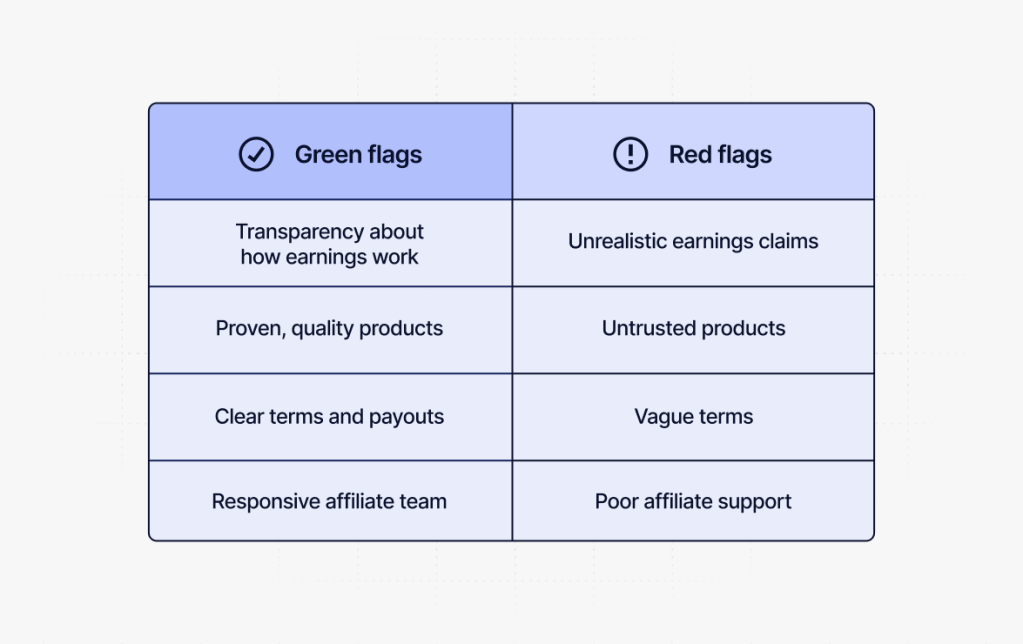
Unrealistic earnings claims
Be cautious of programs that promise easy money or guaranteed income.
Affiliate marketing takes time, consistency, and effort. Any program that suggests otherwise should be approached carefully.
Low-quality or untrusted products
Promoting low-quality products can damage audience trust and hurt your credibility.
If you wouldn’t use the product yourself or recommend it confidently, it’s usually best to move on.
Unclear terms and conditions
A trustworthy affiliate program should clearly explain how commissions work, when payments are issued, and what promotional methods are allowed.
If important details are difficult to find or understand, consider it a warning sign.
Poor communication or affiliate support
If a program rarely communicates with affiliates, ignores questions, or provides little information, it may be difficult to build a successful partnership.
Strong communication is often a sign that a company values its affiliate relationships.
Should you join multiple affiliate programs?
Many successful affiliates promote products from multiple companies, but that doesn’t mean you should join dozens of programs right away.
While it’s tempting for beginners to apply for dozens of programs, it’s often better to focus on a small number of high-quality affiliate programs that align closely with your audience. This approach allows you to learn what works specifically for you, create better content, and build trust with your readers. It’s also important to keep in mind these essential tips to succeed as a hosting affiliate.
As your audience grows, you can gradually expand into additional affiliate partnerships that complement your existing content.
What to do if you’re rejected by an affiliate program
Getting rejected from an affiliate program can feel discouraging, but it’s more common than most beginners expect and it doesn’t necessarily reflect your long-term potential.
In fact, a high percentage of applications that are rejected despite being otherwise good candidates come down to incomplete or unclear application details. This can include missing website or social media links, typos in URLs, or websites that are not fully functional or are still under construction. These issues can make it difficult for a program to properly evaluate your application.
If this happens, start by reviewing the program’s requirements and your application. Once you’ve corrected any issues in your network profile, you can reach out to the affiliate team to request another review. Be sure to include your affiliate ID so your application can be quickly located and reassessed.
In many cases, rejection simply means the timing or fit isn’t quite right yet. Some programs prioritize factors like established traffic, content quality, audience fit, or geographic focus. If that’s the case, use it as a chance to strengthen your foundation.
Focus on improving your content, growing your audience, and making sure your site clearly shows what your niche is and who you serve. Then consider reapplying once you’ve built more traction or refined your positioning.
You can also look for alternative affiliate programs that serve a similar audience or product category. Many strong programs exist at different levels of experience, and starting with one that better matches your current stage can help you build momentum.
Over time, consistent content and audience growth often matter more than a single application outcome.
How to choose the best affiliate program for your goals
Knowing how to pick an affiliate program is less about finding a single “best” option and more about identifying the right fit for your audience, content, and long-term goals. The most successful affiliate partnerships are built on relevance, trust, and consistency, not just commission rates.
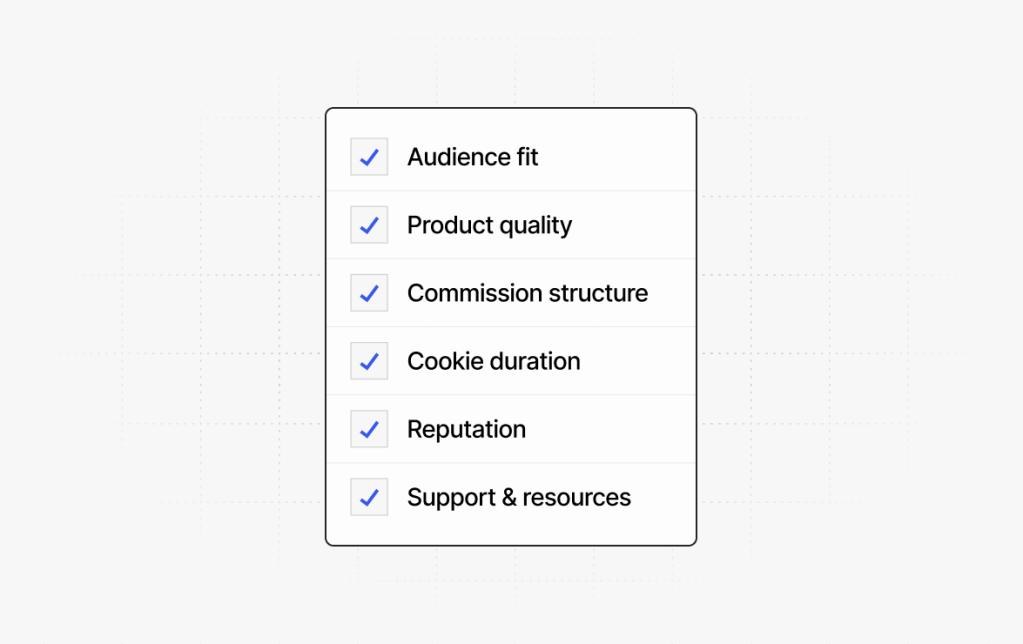
As you compare programs, focus on a few core factors: audience alignment, product quality, brand reputation, commission structure, cookie duration, and the level of support and resources provided. When these elements work together, it becomes much easier to create content that feels natural, helpful, and credible to your audience.
It’s also important to think beyond short-term earnings. A program that converts well and aligns closely with your content can often outperform one that simply offers higher commissions on paper. Strong affiliate relationships tend to grow over time as your content matures and your audience becomes more engaged.
Ultimately, the best affiliate programs for beginners are those that support both sides of the partnership. A good affiliate program should give you the tools to succeed while offering products or services your audience genuinely benefits from. When you prioritize fit over hype, you set yourself up for more sustainable growth and more meaningful results as an affiliate marketer.
If you’re looking for a real-world example of a good affiliate program that aligns with many of the principles covered in this guide, the Automattic Creator Program is a strong place to start. It offers a range of trusted products across WordPress.com and other Automattic brands, along with competitive commission structures, helpful resources, and support designed to help affiliates succeed.
You can learn more about the program here to see if it’s the right fit for your audience and content strategy.
Choosing an affiliate program FAQ
How do I know if an affiliate program is legitimate?
A legitimate affiliate program has clear terms and conditions, transparent commission structures, reliable payment processes, and a reputable company behind it. Research the brand, read reviews, and look for publicly available information before joining. A legitimate affiliate program will never charge you a fee to join.
What is a good commission rate for affiliate marketing?
A good commission rate depends on the industry, product type, and conversion potential. Higher commission rates can be attractive, but product quality, audience fit, and brand trust often have a greater impact on long-term earnings.
Should I choose affiliate programs based on commission rates alone?
No. Commission rates are important, but they shouldn’t be the only factor in choosing to join an affiliate program. A program that aligns closely with your audience and offers trusted, high-quality products will often perform better than a higher-paying program with low relevance or weak conversion rates. Long-term success in affiliate marketing depends more on fit, trust, and content quality than commission percentage alone.
Is it better to join one affiliate program or several?
Many affiliates eventually join multiple programs, but affiliate marketing beginners often benefit from starting with a few high-quality partnerships. This makes it easier to learn, create focused content, and understand what resonates with their audience.
What should I look for before joining an affiliate program?
Before joining an affiliate program, evaluate audience fit, product quality, commission structure, cookie duration, brand reputation, and available affiliate resources. These factors can help determine whether a program is a good long-term fit.
What types of websites or creators can join affiliate programs?
Most affiliate programs are open to a wide range of creators, including bloggers, content creators, influencers, educators, and business owners. Approval typically depends on factors like content quality, audience relevance, and compliance with program guidelines. You don’t always need a large platform, but you do need a clear niche and content that demonstrates how you plan to promote products.
How long does it take to get approved for an affiliate program?
Approval times vary depending on the program. Some programs, like the Automattic Affiliate Program, approve applications within a few days, while others may take longer. Factors like incomplete profiles or missing website URLs and social links can delay the process. In general, having a complete, accurate application helps speed up approval.
Do I need a large audience to start affiliate marketing?
No, a large audience isn’t required to get started. Many affiliate programs accept creators with small or emerging audiences with relevant content and a clear niche. What matters most is the quality of your audience engagement and how well your content aligns with the products you’re promoting.

